About Walter Sisulu
Get in touch
Email Address:
Contact Numbers:
Mthatha: 047 502 2100
Butterworth: 047 401 6000
East London: 043 702 9200
Potsdam: 043 708 5200
Chiselhurst: 043 709 4000
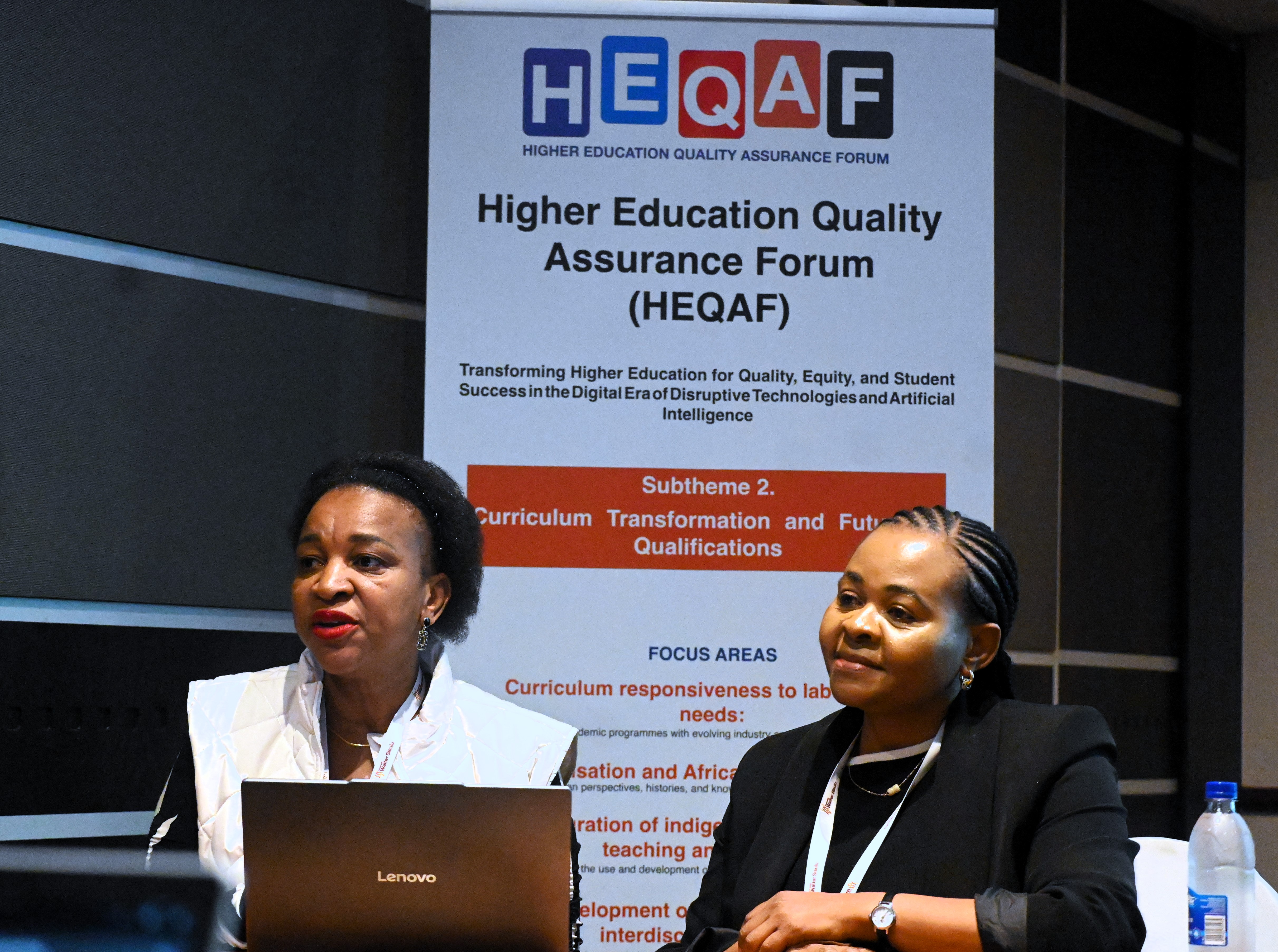 Technology is reshaping how universities operate, pushing quality assurance beyond rule-following towards a strategic driver of improvement, researchers told the 3rd Annual Higher Education Quality Assurance Forum (HEQAF) at iYunivesithi Walter Sisulu Conference on Wednesday.
Helen Matshoba and Zanele Mashiane, quality assurance practitioners from the University of South Africa (UNISA), said higher education institutions could no longer rely on manual, compliance-driven systems in a rapidly digitising environment.
“These developments, the quality assurance, higher education, are also increasingly moving away from narrow, compliance-driven approaches towards more comprehensive systems of quality assurance that are digital, adaptable, and responsive,” Matshoba said.
The pair presented findings from a study that examined how traditional quality assurance processes intersected with new digital systems, using institutional policies, stakeholder feedback, reports and academic literature to ensure their conclusions were robust.
Mashiane said internal quality assurance (IQA) had to become a tool for improving the institution rather than merely reporting information to regulators.
“The Internal Quality Assurance (IQA) should become a tool in improving the institution rather than reporting information to regulators,” Mashiane said.
They applied the 5R Framework, reporting, responding, relating, reasoning and reconstruction, to analyse past practices and identify gaps when manual processes were merged with digital platforms.
The researchers identified three main areas for improvement. First, quality assurance had to move beyond ticking boxes and instead help universities identify challenges, improve services and make better decisions.
Second, digital tools such as quality assurance dashboards could make information easier to access and support more efficient reviews, although slow approval processes could limit their effectiveness. Third, quality assurance staff needed more training and support to fully adopt and use digital systems.
Overall, the study found that quality assurance must balance regulatory compliance with continuous improvement, and that technology, effective institutional processes and skilled staff had to work together to enhance the quality of education and university services.
The forum, held under the theme “Transforming Higher Education for Quality, Equity, and Student Success in the Era of Disruptive Technologies and Artificial Intelligence”.
By Somila Mandongana
Walter Sisulu University
Every gift moves us forward.

The Walter Sisulu Legacy Fund is an opportunity for alumni, staff, partners and friends of the University to invest in the long-term future of Walter Sisulu.
It exists to expand opportunity for students, support academic excellence and innovation, respond to strategic priorities, and build a more resilient institution.
Why give? Because the strength of a university is built across generations. Your contribution helps Walter Sisulu to:
Join the movement. Watch the Fund grow. Add your name to the legacy.