 Languages:
 My WSU | Student Life | Enterprises | Media | Support Services | Vision 2030 | Procurement | Tenders | Contact

NAVIGATING THE FUTURE: AI'S TRANSFORMATIVE ROLE IN POSTGRADUATE EDUCATION
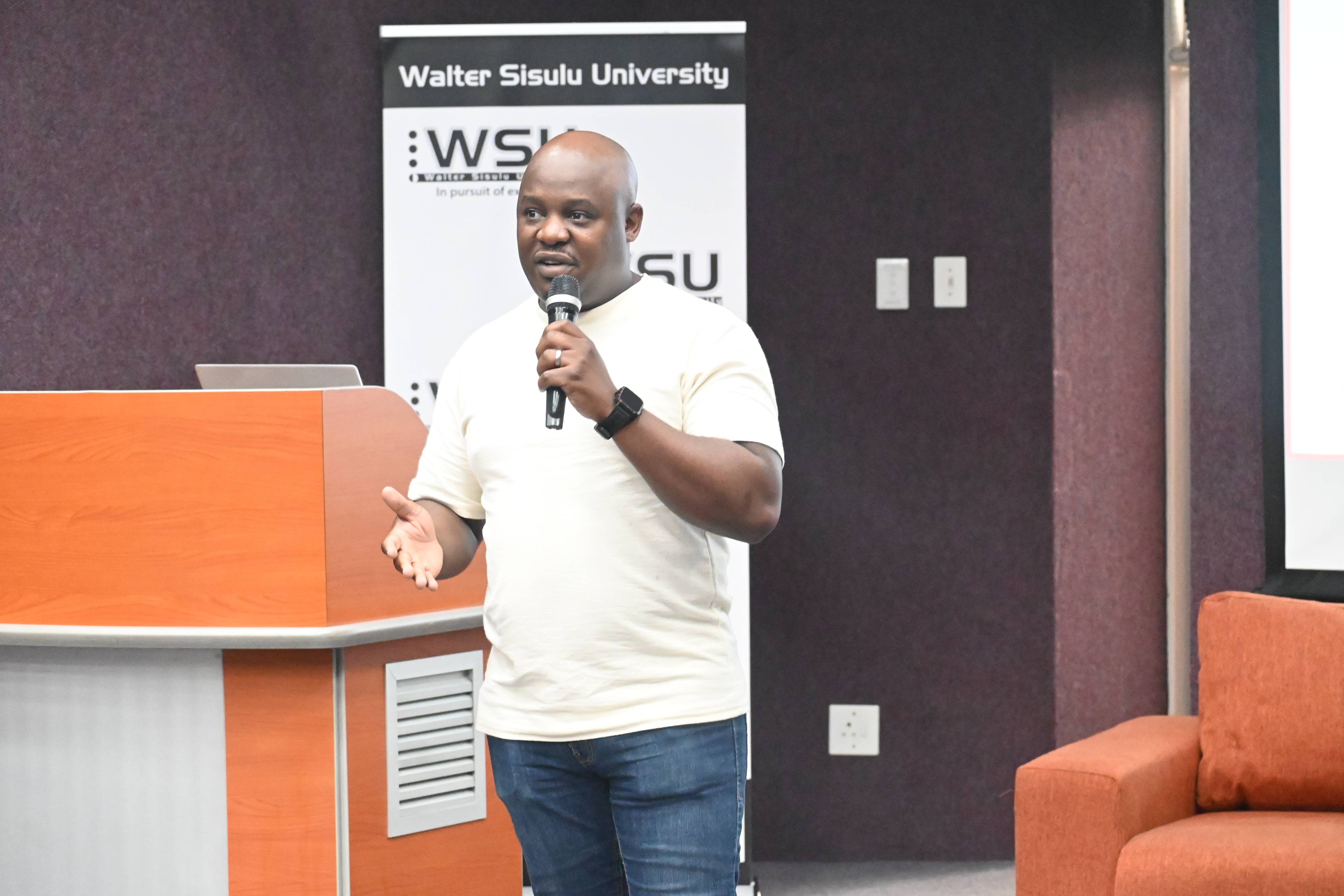 Artificial intelligence is no longer a distant possibility hovering at the edges of academia, it is reshaping the heart of postgraduate education according to WSU researcher.
Prince Daughin Ngqabutho Ncube from the Networking and IT Support Department engaged an audience at the Research and Innovation Day and placed AI firmly within the realities of a world marked by constant change and instability.
“Higher Education is shifting, and institutions must rethink how they support both supervisors and students in this evolving landscape”, said Ncube.
Ncube’s research titled: “Role of Generative AI in Transforming Mentor-Mentee Relationships and Supervision Dynamics in Postgraduate Education,” began by addressing the unquestionable force of technological disruption.
“AI is transformative, AI is disruptive, it is just like how most of you had to change to use the calculator, no one complains about the calculator doing people's calculations, AI is going there,” said Ncube.
With this comparison, he placed AI as not a threat, but as the next unavoidable tool that academia must learn to work with rather than against.
Ncube highlighted that postgraduate supervision, mentorship, emotional intuition, and intellectual guidance are irreplaceable.
“Humans and AI can never be swapped around, we need to find a balance, and in finding the balance, we need to understand the capabilities of AI,” Ncube said.
He noted that AI could serve as a powerful amplifier of academic capacity rather than a substitute for human expertise.
“We are being forced into scenarios whereby we either adapt or perish. The rapid acceleration of technology means that institutions that resist change risk being left behind, widening existing gaps in access, opportunity and digital literacy”, he said.
He further said that if they want these graduates to be people who will be able to contribute to the knowledge economy, then they should be able to do it independently.
He stressed that critical thread running through his presentation that there was a need to produce graduates capable of contributing meaningfully to the knowledge economy and that AI can support this by fostering independent thinking, early idea development and self-directed learning.
“AI is not here to erase what makes research human it is here to elevate it, challenge it, and push it forward,” said Ncube.
In his closing, Ncuba raised a call to action for supervisors to embrace new tools, for institutions to build ethical frameworks, and for higher education to rethink its purpose in an era of powerful intelligent systems.
By Amahle Haseni
Contact Us
Email Address:
Contact Numbers:
Mthatha: 047 502 2100
Butterworth: 047 401 6000
East London: 043 702 9200
Potsdam: 043 708 5200
Chiselhurst: 043 709 4000
Follow us on Social Media
 |
 |
 |
 |
 |
 |
