 Languages:
 My WSU | Student Life | Enterprises | Media | Support Services | Vision 2030 | Procurement | Tenders | Contact

GROUNDBREAKING RESEARCH: FOOD WASTE SUBSTITUTION EFFECTS ON SPERMATOGENESIS
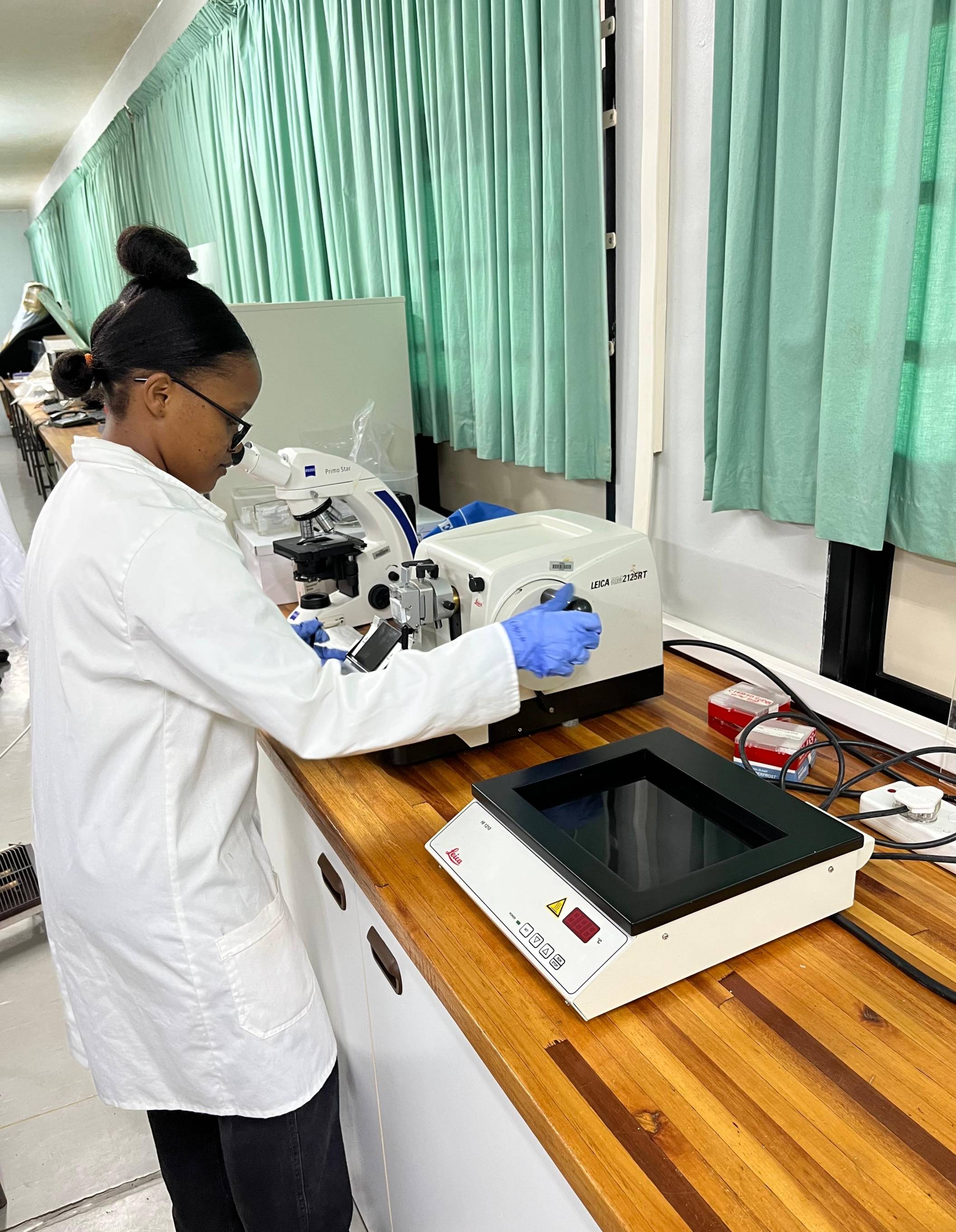 At the Institutional Research and Innovation Day held in Mthatha, Natural Sciences Bachelor of Honours student Tsautse Hlomphehang unveiled compelling evidence that food waste may hold the key to sustainable fish feed, offering a game-changing solution for global protein production and ecological conservation.
The study is aimed at trying to bridge the gap between reproductive biology and the use of food waste as an alternative feed, focusing on spermatogenesis, a process influenced by animal feed.
Tsautse’s research focused on Juvenile Mozambique tilapia, investigating how food waste might replace traditional fish meal, a practice that currently depletes wild fish population and carries significant environmental and economical costs.
“Aquaculture has been identified as one of the fastest growing industries that produces most of the world’s global protein now. Aquaculture heavily relies on fish meal which is a protein feed that is given to these animals that are reared, fish meal is not only financially expensive but also environmentally expensive,” she said.
Analysis involved observing gonads under a dissecting microscope, noting size, shape, and any deformities to assess testicular development and spermatogenesis.
In her presentation, she revealed that food waste can partially substitute for commercial fish feed, but with a crucial caveat, proper protein is needed to maintain healthy reproductive development fish, proven during the experiment.
“By the presence of the sperm of these cells that are here, it shows that this treatment did undergo all the spermatogenesis stages, which means that this is supported by the underpaid protein,” she said.
She concluded that using food waste as a nutrient-rich supplement may help improve spermatogenesis because studies show it can boost sperm health. This could be a simple and sustainable way to support reproductive health however more research is needed.
By Mahle Sokiti
Contact Us
Email Address:
Contact Numbers:
Mthatha: 047 502 2100
Butterworth: 047 401 6000
East London: 043 702 9200
Potsdam: 043 708 5200
Chiselhurst: 043 709 4000
Follow us on Social Media
 |
 |
 |
 |
 |
 |
