
Languages:
Staff Apps | Enterprises | Media | Support Services | Vision 2030 | Procurement | Tenders | Contact
Staff Apps | Enterprises | Media | Support Services | Vision 2030 | Procurement | Tenders | Contact
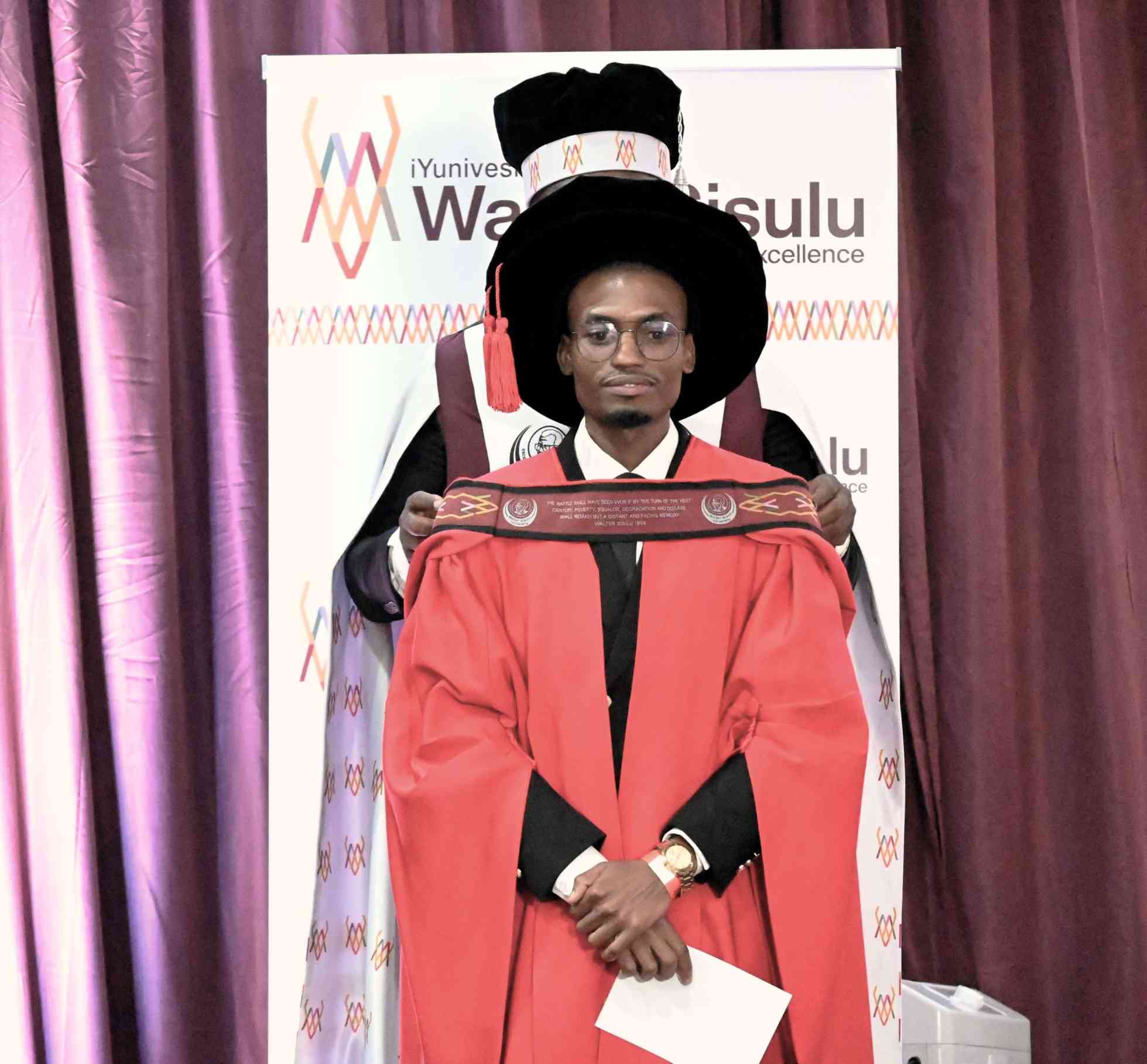
In a hall filled with celebration at the opening of the iYunivesithi Walter Sisulu graduation ceremonies in Mthatha Campus on Monday, one of the most quietly powerful moments belonged to Dr Sizwe Masuku, a physicist whose work explored far beyond the visible world into the hidden behaviour of matter that powers modern life.
Dr Masuku was awarded a Doctoral Degree of Philosophy in Health Sciences on Monday afternoon.
His doctoral thesis, titled Electron Spin Resonance and Magnetic Study of ZnxCo1-xAlFe2-xO4 (0 < x ≤ 0.9) and Zn0.7Ni0.3 RE0.1Fe1.9O4 (RE= Gd, Sm, Dy) Nanoferrites, explored how extremely small magnetic materials behave when altered at atomic level, and how those changes can be translated into real-world technological solutions.
In simpler terms, his study focused on nanoferrites materials so small they cannot be seen by the naked eye yet powerful enough to shape communication systems, sensors and even medical tools of the future.
Dr Masuku explained that his work was born from both his scientific curiosity and a desire to respond to real societal needs.
“The journey toward my doctoral research was driven by a deep curiosity about how materials behave at the smallest scales and how this knowledge can be used to solve real-world problems,” he said.
He added that his motivation was also shaped outside the laboratory.
“My teaching experience and engagement with students played a significant role, seeing students struggle to connect abstract physics concepts with real-life applications motivated me to pursue research that bridges that gap something scientifically advanced, yet practically meaningful,” he added.
At the centre of his findings was a phenomenon known as low-field microwave absorption, a discovery that could improve how future communication systems, sensing devices and diagnostic tools are designed, making them more efficient and accessible.
“This research matters because these materials can be used to develop faster, more efficient electronic devices, improve communication systems, and even contribute to medical diagnostics,” he said.
Dr Masuku hoped his work does not remain confined to academic spaces alone, but contribute to the development of affordable and efficient technologies, particularly in areas where access is limited.
He added that he hoped it would inspire young scientists from underrepresented communities.
“In many parts of South Africa and beyond, there is a growing demand for efficient communication systems, affordable diagnostic tools, and sustainable technological solutions. I wanted to contribute to this space by exploring materials that could potentially improve these systems,” he said.
However, according to Dr. Masuku his PhD was deeply personal as it represented years of perseverance, discipline, and sacrifice and describing it as a milestone that carried meaning not only for himself, but for his family and community.
“Coming from a background where such milestones are not always easily accessible, this achievement carries significant meaning not only for me, but for my family and community,” he said.
To those who wished to follows the same path, he shared a heartfelt message that one should stay committed and be patient with self, and never underestimate the power of consistency.
“The journey is challenging, but it is also incredibly rewarding. Believe in your vision, even when the path is unclear,” he concluded.
By: Yolanda Palezweni