
Languages:
Staff Apps | Enterprises | Media | Support Services | Vision 2030 | Procurement | Tenders | Contact
Staff Apps | Enterprises | Media | Support Services | Vision 2030 | Procurement | Tenders | Contact
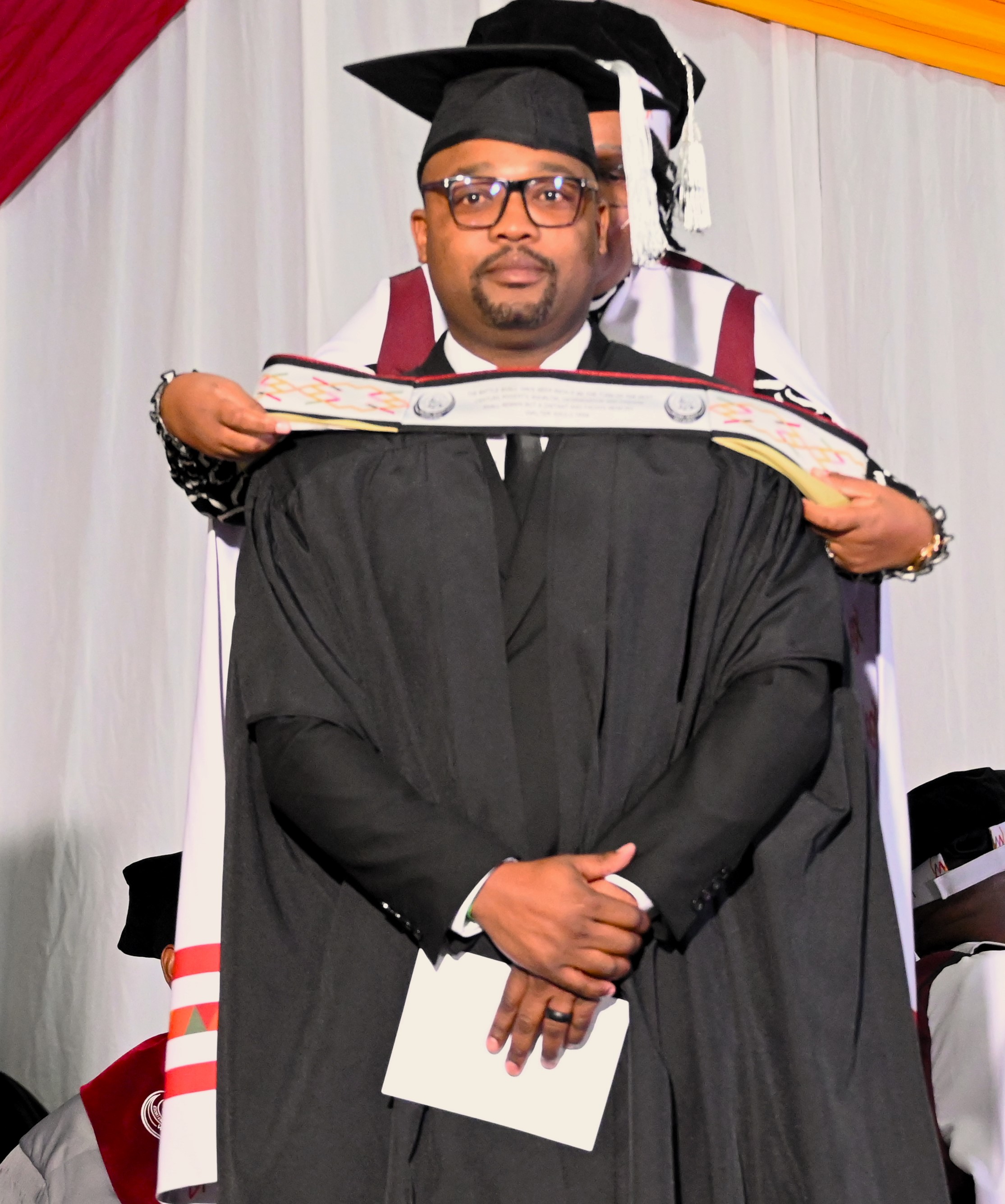
Three years after he was awarded runner-up for the second-best presentation on local economic development at the second BRICS Research Forum held in Cape Town in 2023, Public Administration Master’s graduate Sanele Moshoetsi has once again come up with another impressive research project which this time has thrust him to the global stage.
Fresh from graduating with a Master’s Degree in Public Administration at the iYunivesithi Walter Sisulu’s Butterworth Campus, Moshoetsi’s research project exploring local realities has earned international recognition.
His dissertation, titled: The Impact of Leadership on Transforming the Township Economy of Local Businesses: A Case Study of Mnquma Local Municipality, explored how leadership within municipalities can unlock economic opportunities, strengthen local businesses and improve living conditions within township communities.
He has now been accepted to present at the fifth BRICS Research Institute conference in Brazil, where discussions would focus on robotics, artificial intelligence and their impact on local economic development.
“The whole concept and idea were to probe further and understand the economic landscape,” he said.
“What you would find is that our people were marginalised for so long and now we are in academic spaces to turn around such ills of the past and make it a point that our people find space to manifest within the economic space,” he added.
At the centre of his work is a desire to see township communities move beyond dependence and towards sustainable economic participation.
His research seeks to encourage municipal leaders, activists and local stakeholders to rethink development strategies in ways that create opportunities for people living below the poverty line.
“There are people that are living below poverty level that can actually have their own businesses going and be able to fend for themselves besides just waiting for provisions of government,” he explained.
“So, the paper aimed to ignite municipal officials, local leaders and community activists to actually take up the work and try to address the economic issues of the people on the ground,” he added.
For Moshoetsi, universities have a greater responsibility beyond producing graduates.
He believed that higher education institutions should actively contribute solutions to societal challenges through research, innovation and knowledge production.
“A university is not just a teaching and learning space anymore. It is more of a research-based institution so that it can drive knowledge and come up with new inventions. Innovation is the new world order now,” he said.
Behind the achievement is also a deeply human story of sacrifice, resilience and determination. Balancing postgraduate studies while working full-time at the university during the demanding Rationalisation and Consolidation programme became one of the greatest challenges of his academic journey.
Between work responsibilities, family life, activism and research deadlines, Moshoetsi often found himself stretched beyond limit.
“The academic journey is never easy and never ending. It’s a very strenuous journey. Sleepless nights,” he reflected.
“You work extraordinary hours and, in this day, and age you have to juggle families, work and academics all at once,” he added.
He also credited difficult moments with his supervisor for sharpening his focus and discipline throughout the journey.
Despite the pressures, he remained committed to producing work that could contribute meaningfully to society and to the university’s Vision 2030 trajectory centred on innovation, transformation and community impact.
More than a personal milestone, Moshoetsi viewed the qualification as a responsibility to inspire young people from disadvantaged communities to recognise education as a tool for liberation and development.
“It means I need to work harder. More than doing this thing for myself, I feel that I owe it to the community that I come from and to the child sitting in high school or primary school who lacks motivation and does not understand the worth of education,” he said.
He added that education should ultimately serve communities and help African societies tell their own stories and shape their own futures.
“My message to fellow staff and students would be that education means service to Africa as Robert Mangaliso Sobukwe once said,” he said.
“If we continue in this trajectory of acquiring knowledge and developing our own knowledge, we will be able to tell our own stories and transform the economic disparities that we are faced with,” he concluded.
By: Yolanda Palezweni