
Languages:
Staff Apps | Enterprises | Media | Support Services | Vision 2030 | Procurement | Tenders | Contact
Staff Apps | Enterprises | Media | Support Services | Vision 2030 | Procurement | Tenders | Contact
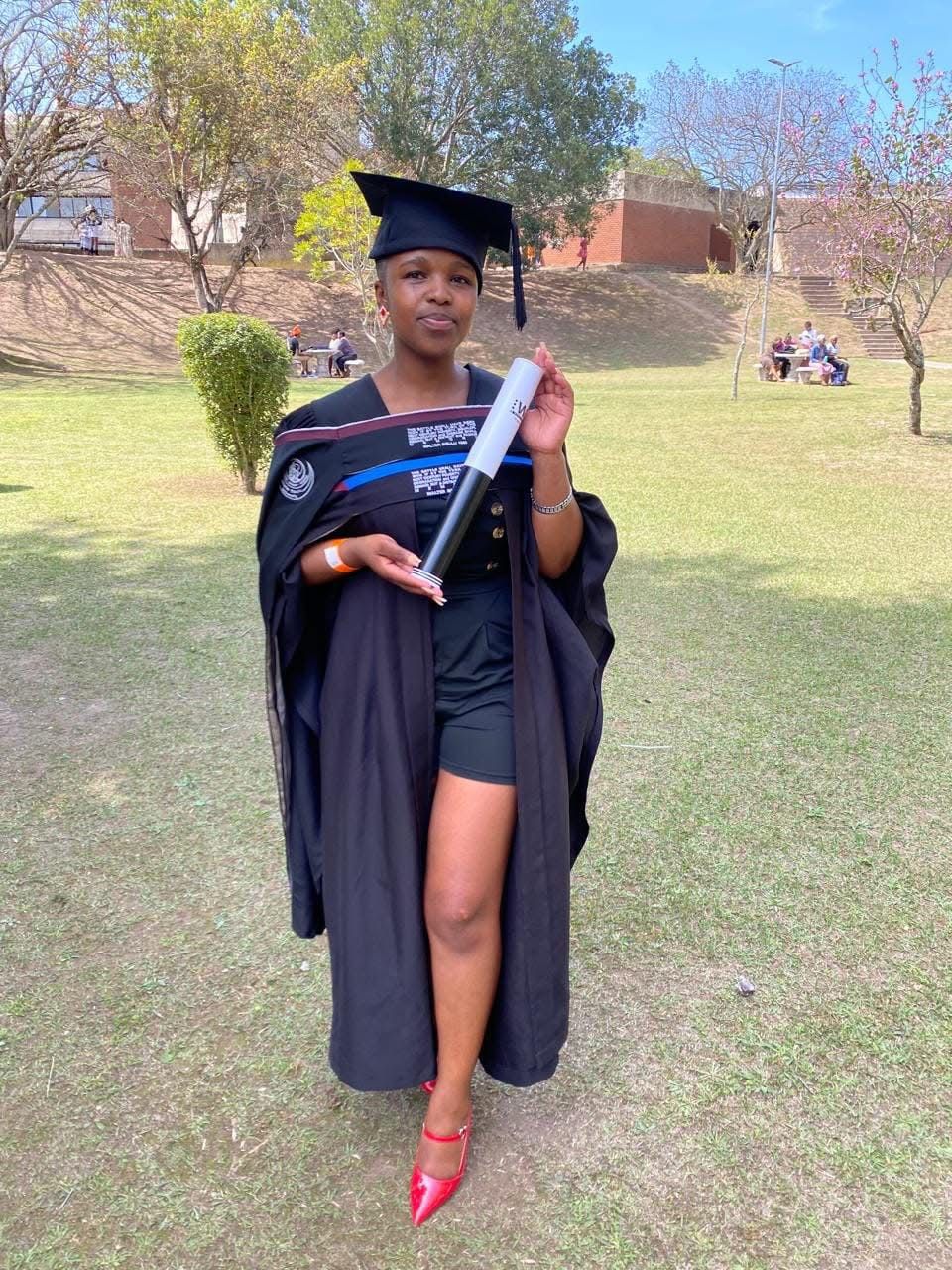 At just second-year master’s level, iYunivesithi Walter Sisulu student Nthotsejane Keketso is breaking new ground by becoming one of the first students at the institution to produce academic research in her mother tongue, Sesotho.
This milestone follows the Memorandum of Understanding (MOU) signed in 2024 between the University of the Free State and iYunivesithi Walter Sisulu to strengthen partnerships aimed at expanding knowledge production and promoting indigenous African languages in higher education.
Keketso, who is pursuing a Master of Arts in African Languages under the Faculty of Law, Humanities and Social Sciences, is conducting a study titled “Thsekatsheko ya ditlamorao tsa thehello ya mabitso ho baphetwa dipaleng tse pedi tsa Sesotho” (Analysis of the effects of noun formation on characters in two Sesotho stories).
Her study explores how names can show what characters are like, how they connect to their surroundings, and how these elements contribute to the overall structure of the story. It also examines whether naming practices in Sesotho literature have evolved across different historical periods.
For Keketso, conducting her research in Sesotho was both personal and purposeful.
“I chose to write my research in my home language, Sesotho, because I believe our literature should be studied and presented in the language in which it was written. I wanted to contribute to preserving and developing Sesotho in education and higher learning,” she said.
She explained that one of the greatest challenges was the limited availability of academic terminology in Sesotho.
“Many academic terms do not exist in Sesotho, so I had to coin them or explain them clearly. Most of my studies have been written in English and, as a result, we are losing our home language,” she said.
Despite these challenges, Keketso hopes her journey will inspire other students to embrace African languages in research and scholarship.
“If I can do it, you can too. When we write and study in Sesotho, we help our language grow and survive for future generations,” she added.
Acting Head of Department of African Languages, Moeketsi Letuka, described the achievement as an important milestone for the department, the university, and the development of Sesotho language studies.
“This will put the department and the university on the map as an institution that works hard to promote indigenous languages. Her research will also serve as a terminology template for upcoming students and show that it is possible to conduct academic research in African languages,” said Letuka.
Acting Manager for Languages and Indigenous Knowledge Systems (IKS), Sinoyolo Nokutywa, highlighted the importance of Indigenous Knowledge Systems in transforming higher education and strengthening African scholarship.
“Writing academic work in one’s mother tongue is a sign of pride and identity. It contributes to the promotion, preservation, and growth of the language,” he said.
Keketso’s achievement reflects iYunivesithi Walter Sisulu’s continued commitment to promoting indigenous languages, advancing African scholarship, and creating space for African knowledge systems within higher education.
By Amahle Haseni