
Staff Apps | Enterprises | Media | Support Services | Vision 2030 | Procurement | Tenders | Contact
Staff Apps | Enterprises | Media | Support Services | Vision 2030 | Procurement | Tenders | Contact
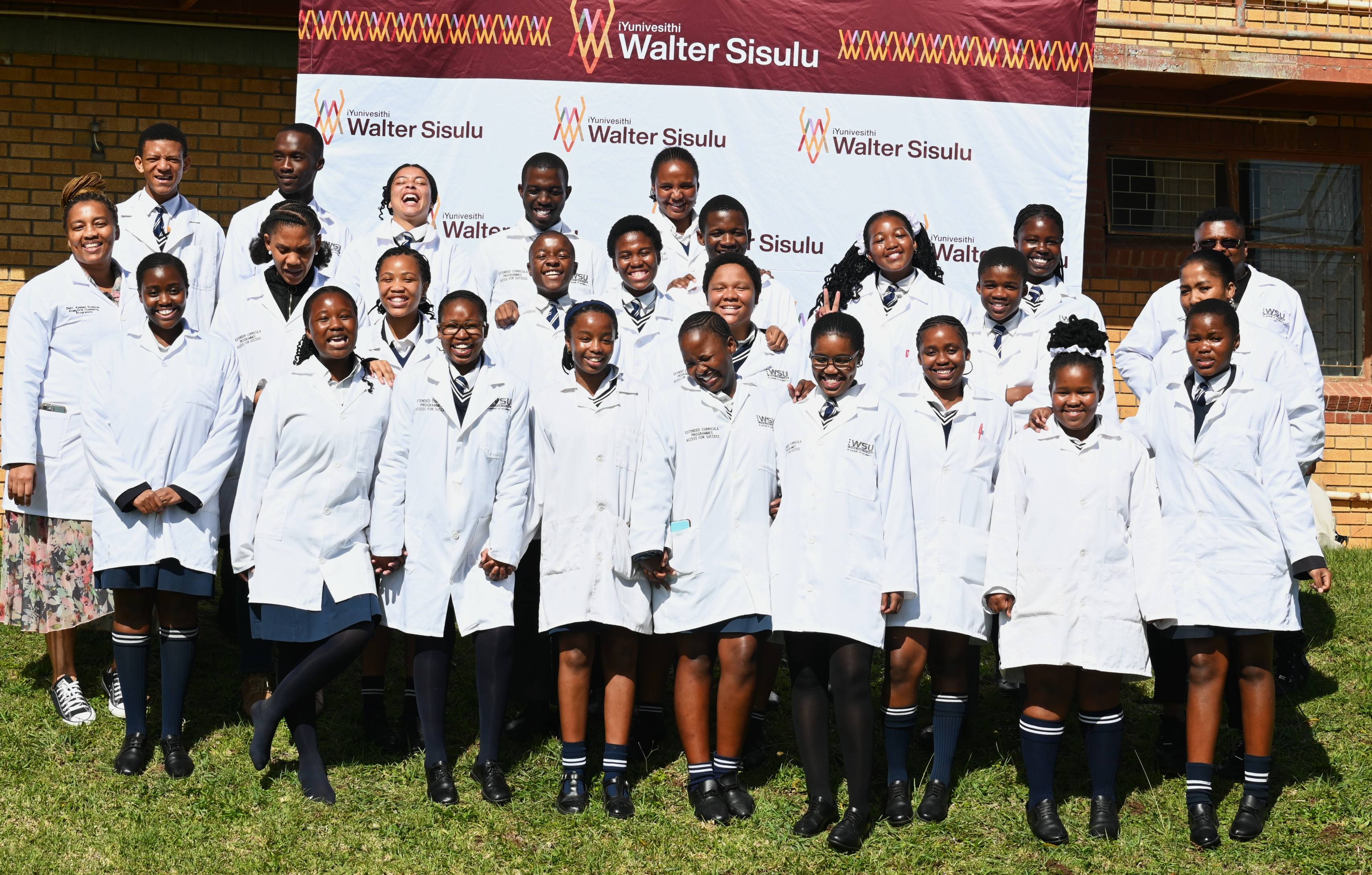
For 22 Grade 11 learners from Ngwenyathi Public School, the opportunity to step into the laboratories at Walter Sisulu was more than a school excursion, but an encounter with possibility.
As they tilted flasks, measured liquids, handled pipettes and watched experiments unfold, science moved beyond the pages of a textbook and became tangible, practical and alive.
For Physics enthusiast Asange Mohono, the experience at Walter Sisulu’s analytical chemistry laboratory at the Potsdam Site helped demystify a concept she had struggled with while opening her eyes to a possible future in Chemistry.
“My favourite part of the day was the experiment on titration. I must say that, before today’s experience, I was struggling a bit with titration, but having actually done the experiment in an actual lab, with actual equipment, helped me gain a better understanding of titration,” she said.
The experience has also strengthened Mohono’s ambition to become an organic chemist - a dream that now feels more attainable.
Her experience captures the essence of the CHIETA-funded Science Intervention Programme, designed to bring university resources, expertise and practical learning opportunities closer to learners who may have limited access to specialised facilities.
Spearheaded by the Institutional Advancement Office, the programme seeks to bridge the gap between classroom learning and practical scientific experience.
“We applied for the Special Project Funding from CHIETA and, through the programme objectives, this community engagement project was conceptualised around a rural high school to provide Mathematics and Science academic support,” said Walter Sisulu Institutional Advancement Office Director Sitembele James.
Launched in May and scheduled to conclude in September, the project is driven by the University’s Department of Applied Sciences in the Faculty of Natural Sciences.
Led by Associate Professor, Prof Raymond Taziwa, university lecturers regularly visit the school to provide additional academic support in Mathematics, Physics and Chemistry.
The lessons reinforce the curriculum while exposing learners to concepts and methods that form part of the transition from secondary school to university.
“Each week, our facilitators work with learners on the topics they find most difficult, so that learners don’t just hear about science, but get to see it and do it for themselves,” said Taziwa.
For the HOD, the intervention is about more than improving marks, but about cultivating confidence, curiosity and the intellectual habits required of future scientists.
“Through such interventions, we also build their confidence, their thinking skills and their ability to work like real scientists, asking questions, testing ideas and drawing conclusions from what they find,” said Taziwa.
In conclusion, James said by bringing university laboratories and lecturers closer to learners, the programme is helping turn scientific curiosity into confidence, and classroom dreams into possible careers.
By Thando Cezula