
Languages:
Staff Apps | Enterprises | Media | Support Services | Vision 2030 | Procurement | Tenders | Contact
Staff Apps | Enterprises | Media | Support Services | Vision 2030 | Procurement | Tenders | Contact
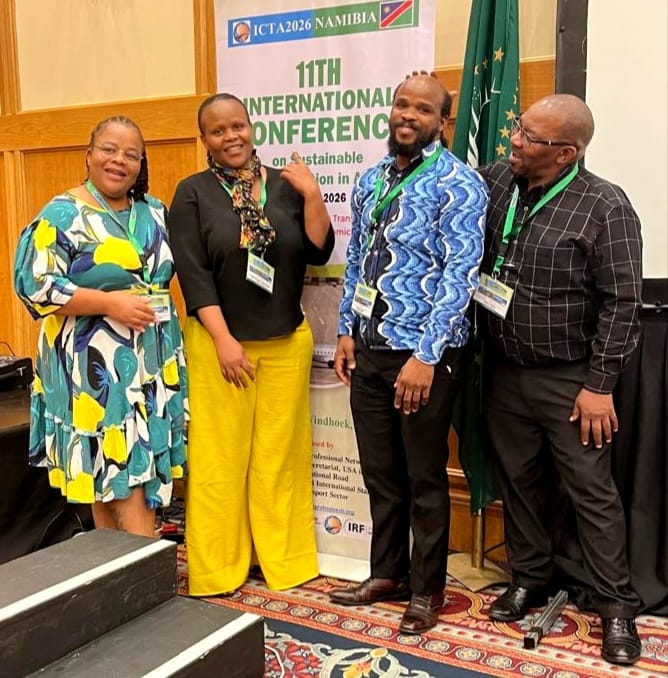
A quartet of academics from Walter's Faculty of Engineering, Built Environment and Information Technology (FEBEIT) has showcased the university's growing research excellence on the continental stage after presenting pioneering studies at the 11th International Conference on Sustainable Transportation in Africa in the Namibian capital, Windhoek.
Representing the university were the Head of the Department of Built Environment, Prof Nokulunga Mashwama; the HOD of Mechanical Engineering, Mr Zamile Mpeta; the Civil Engineering lecturer, Mr Mbulelo Phesa; and the Built Environment lecturer, Ms Nomkhitha Luke.
Together, they demonstrated how research emerging from Walter Sisulu is helping shape practical, African-led solutions to challenges in transport, infrastructure, climate resilience and technological innovation.
Convened under the theme "Sustainable, Safe and Smart Transport, Logistics and Tourism for Economic Growth," the conference brought together leading researchers, policymakers and industry experts from across the continent to explore ideas capable of transforming Africa's transport landscape.
"A total of four papers connected to Walter Sisulu researchers were presented at the conference, spanning smart mobility, climate resilience, regional economic development and technology transfer," said Mashwama.
Leading the university's contribution, Mashwama presented "A Data-Driven Dashboard for Identifying Road-Safety Hotspots in South African Cities," a paper introducing an innovative open-data dashboard that enables planners and policymakers to identify and visualize road accident hotspots.
Drawing on Road Traffic Management Corporation crash records, OpenStreetMap road network data, and advanced spatial analysis, the research identified persistent accident hotspots along major transport corridors and revealed emerging risks in rapidly growing communities.
"The resulting interactive tool gives planners and policymakers a practical, low-cost way to prioritise road-safety interventions and supports global commitments to safer, more sustainable cities," she said.
Phesa's research, titled "Implementing Climate-Resilient Embankment Infrastructure in Wetland Ecosystems: A Case Study of Zambia," explored how infrastructure can be developed sustainably in environmentally sensitive wetlands.
His findings highlighted the importance of involving local communities throughout the planning, construction, and maintenance of embankment infrastructure, demonstrating that community participation strengthens project ownership and draws on valuable indigenous knowledge.
"The research recommends climate-smart construction techniques, ongoing environmental monitoring, and supportive policy frameworks to guide future climate-adaptive infrastructure in wetland regions," said Phesa.
Mpeta turned his attention to sustainable economic development through his paper, "Green Corridors as Catalysts for Regional Economic Development and Industrial Competitiveness: A Systematic Synthesis."
Based on a review of literature published between 2018 and 2025, the study introduced the "Green Corridor Virtuous Cycle" - a conceptual model illustrating how green transport corridors can reduce logistics costs, attract environmentally conscious investment, stimulate knowledge-intensive employment and strengthen Africa's participation in global green value chains.
"The model demonstrates how sustainable transport infrastructure can become a catalyst for regional economic growth and industrial competitiveness," Mpeta explained.
Luke completed the quartet's impressive showing with her paper, "Technology Transfer Centres for Promoting Effective Transportation Technologies in South Africa: A Systematic Review," which examined the role of Technology Transfer Centres in accelerating the adoption of intelligent transport systems and electric mobility technologies.
Her research found that while these centres serve as critical bridges between academia, industry and government, their impact is often constrained by inconsistent funding, fragmented policy coordination and persistent skills shortages.
"These challenges call for a shift from ad-hoc projects toward strategic, well-resourced Technology Transfer Centre ecosystems that actively engage South Africa's informal transport sector," Luke said.
Beyond presenting her own research, Mashwama made a significant scholarly contribution to the conference by co-authoring several additional papers and chairing a number of technical sessions on Artificial Intelligence, Sustainable Transport, Smart Mobility, Transportation Planning, GIS and Geospatial Innovation.
By Thando Cezula